There is something profoundly strange about the days before a life-altering operation.
Time behaves oddly. You are moving towards something enormous, something that will alter the way you understand yourself and the way the world understands you, while ordinary life continues interrupting you with its usual indignities.
Systems break.
Your body finds a new way to break down.
You answer emails.
You respond to the doctor’s office. Then the next doctor’s office.
You have to work.
Life refuses to pause for the enormity of what is happening to you.
I am in that strange place now.
In a matter of days, I will undergo cochlear implant surgery.
The cochlear implant is the current challenge, but it’s just one part of my medical reality. Hearing loss is only one aspect of a life shaped by chronic issues: fluctuating symptoms, pain, fatigue, and navigating complex systems. The work of surviving shapes everything.
I have been trying, and often failing, to write about it. Perhaps because writing requires some measure of coherence, and coherence has been difficult to come by. Fear clouds things. Exhaustion clouds things. Pain clouds things. Unsedatable anxiety clouds things.
So does grief.
Because grief is what this is. Not all of it, but enough of it.
I have been thinking about the cochlear implant as the big, scary thing. Not because surgery itself is the only frightening part, though surgery is frightening enough. It is frightening because it represents a shift in identity.
It is a shift in how I understand myself, how I move through the world, and how I am seen in it. Hearing aids are not the same kind of disability marker as a cochlear implant, and that is a shift.
It marks something.
And I am not entirely sure I am ready for that.
Maybe some people who have travelled this road will say the shift from hearing aids to a cochlear implant is not all that dramatic.
Maybe for them it was not.
But burdens are not comparative exercises. Each of us carries our own. Mine are shaped by the cumulative work required simply to survive. Forget thrive, I am past that. Survival itself has become work. Work that extends beyond the body into how you think, feel, and move through the world.
It is not only heavy for me but also for those around me.
Heavy for my family.
Because here is something we do not talk about enough: disability changes the geography of an entire family. This shift extends well beyond the individual.
Disability does not happen to just one person.
It happens to everyone in orbit.
To partners. Parents. Children. Friends.
To the people who watch someone they love suffer and would give almost anything to take it away, but cannot.
Too often, though, we think of illness as singular. Discrete.
Someone got sick.
Someone had surgery.
Someone recovered.
As though these are self-contained events with neat beginnings and endings.
But chronic illness, disability, and overlapping medical conditions do not work that way.
They are not linear.
Sometimes episode one collides violently with episode seven.
One condition triggers another. One medication creates another problem. Symptoms disappear, only to return in some new and imaginative form. You enter remission and dare to hope, only to find that remission itself is temporary.
People on the outside see incidents.
The person living it carries the whole history.
They can trace the changes, the pain, the medications, and the suffering over the years. Across diagnoses. Across specialists. Across conditions others may treat as separate. The body experiences them as cumulative.
They learn medications by name. Their dosages. Their side effects. The alternatives when those fail.
Maybe, like me, they find themselves negotiating with the anaesthesiologist about the best way to be knocked out.
“Yes, I am sensitive to morphine, but you are going to use it anyway and push the prophylactics like it’s a business.”
They know it is all connected.
And sometimes, if we are being honest, it is a profoundly shitty reality.
If someone had asked me whether I wanted this life, I would have opted out long ago.
But no one asks.
No one chooses this.
And yet, people sometimes speak of major medical interventions as though they were elective. Optional. Lifestyle-adjacent.
As though one wakes up one morning and casually thinks, “You know what would really spice things up? Brain-adjacent surgery.”
No.
People choose these things because the alternatives become untenable.
The choice is rarely between comfort and discomfort.
Often, the choice is between suffering now and greater suffering later.
And layered on top of disability itself is something we rarely acknowledge: the labour of surviving it.
Disability is work.
Constant work.
There is, of course, the labour of illness itself. The pain. The symptoms. The unpredictability. The grief.
But there is also the admin of illness.
The specialists. The referrals. The blood tests. The paperwork. The medication schedules. The endless conversations between doctors who do not always speak to one another.
The negotiations with work.
The explanations to the family.
The emotional labour of reassuring everyone around you while quietly terrified yourself.
Researchers have language for this. They call it treatment burden or illness work, the invisible labour patients undertake simply to remain alive and functioning. It is real. Studied. Documented.
And exhausting. The continuous nature of this work wears down even the most resilient.
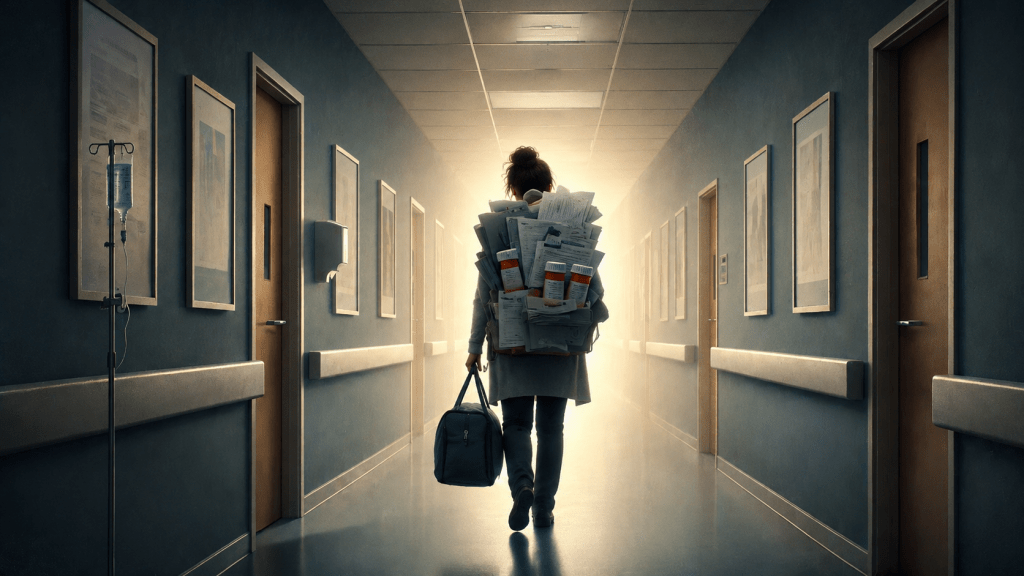
Because sometimes even the people meant to help you do not fully understand the system, and suddenly you are not simply a patient. You are a project manager, coordinator, translator, advocate, and administrator of your own survival.
People who do not live this life rarely see that part.
They see the diagnosis, but not the bureaucracy.
They see the treatment, but not the accumulation.
They see the surgery, but not the years and months of organising life around survival.
And then, layered upon all this, there is something subtler, harder to name, but no less exhausting.
The strange expectation of gratitude.
Not gratitude in the ordinary sense. Gratitude is human. We all feel it when people show care, generosity, and kindness.
And let me be clear: I am grateful. Deeply so.
Grateful for doctors trying to help. For family carrying burdens they never asked for. For friends who stay. For colleagues and an organisation making genuine efforts to accommodate me during an extraordinarily difficult period.
I know how fortunate I am in many ways.
But gratitude and exhaustion coexist.
What I mean is something quieter. The expectation, rarely spoken aloud but often subtly communicated, is that accommodations are acts of extraordinary generosity rather than what makes participation possible.
No one says, You should be grateful we accommodated you.
That would sound cruel.
Instead, you learn to notice tone. Hesitation. The emotional weather in rooms.
The subtle sense that support has cost someone something and therefore ought to be met with visible gratitude.
And perhaps what irritates me most is this: people often do not realise they are doing it.
Because when you live with disability long enough, you become exquisitely sensitive to these dynamics.
You know when support is freely given.
And you know when someone expects emotional payment for it.
Accommodation is not a special dispensation.
Access is not generosity.
Dignity should not require performance.
Because discomfort makes people uncomfortable, there is often an instinct to minimise.
“At least there is treatment.”
“You’ll be fine after surgery.”
“Things will be better once you do XYZ.”
Maybe.
Or maybe treatment helps without fixing.
Maybe things improve. Maybe they don’t. Maybe they improve and then unravel again.
Chronic illness has taught me to distrust certainty.
Please stop offering reassurance as though it were fact.
I know more about where I am than you do.
I have earned my bitterness.
And yes, perhaps bitterness is unfashionable. We seem to prefer people with disabilities to be brave, resilient, and inspirational. We like neat arcs and triumphant endings.
What we struggle with is anger.
What we struggle with is someone saying plainly, “This is hard, unfair, and relentless. This is hell sometimes.”
Not every day.
But enough days.
Still, here I am.
Walking toward the thing.
Kicking and screaming internally some days. Resigned on others. Hopeful, occasionally. Terrified often.
Trying, with whatever dignity I can muster, to move toward something I never asked for but now cannot avoid.
Maybe that is what courage looks like, after all.
Not fearlessness.
Not optimism.
Just walking toward the thing despite yourself.
I do not know who I will be afterwards.
What I know is this:
We will get through it.
Not gracefully.
Not unchanged.
Just through it.
And if there is strength to be borrowed, even a molecule of it, I will take it.
I will need all of it.
To get through this.
Whatever this becomes.


Leave a Reply